How Generative AI Skills: Helps in Analyzing, Big data and Learning Pathways
Organisations generate large amounts of information through customer transactions, digital platforms, business applications and operational systems. Making sense of this information requires analytical skills, appropriate tools and a clear understanding of the…
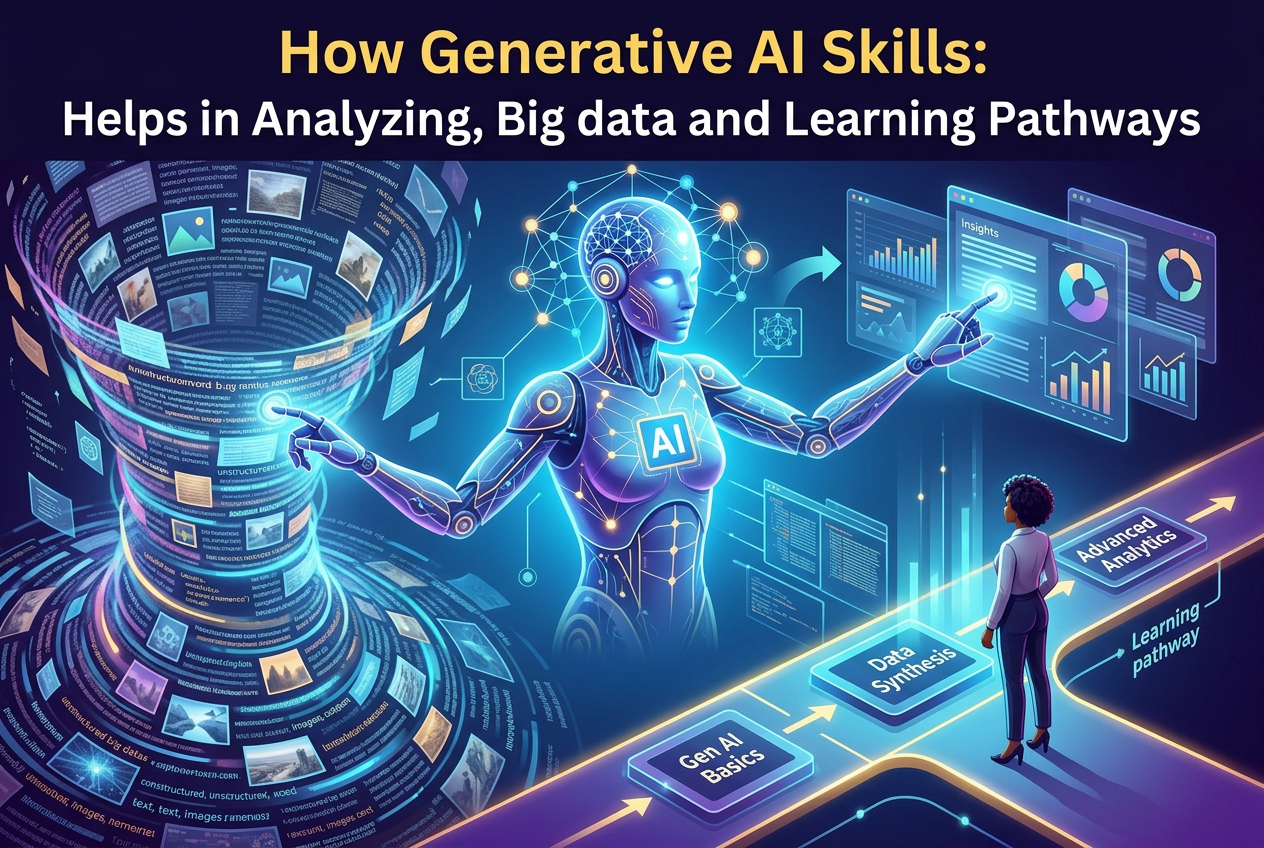
Organisations generate large amounts of information through customer transactions, digital platforms, business applications and operational systems. Making sense of this information requires analytical skills, appropriate tools and a clear understanding of the questions a business needs to answer. Generative AI is becoming another tool that can support parts of this process.
Generative AI can create text, summarise documents, explain code and assist with information discovery. When used alongside established data analysis methods, it may help professionals explore information more efficiently. However, it does not replace the need for data quality checks, statistical reasoning or human judgement.
Understanding Generative AI
Generative AI refers to systems that create new content based on patterns learned during training. Depending on the system, the output may include written text, computer code, images, summaries or structured responses.
Related: A Better Online Experience Starts With Making Things Easier for Customers · Basic Accounting Principles Every Owner Should Know
Large language models are one important category. They process and generate language, making them useful for tasks such as drafting explanations, summarising documents and assisting with programming.
These systems can produce plausible but incorrect information. Users should therefore verify important claims, especially when working with financial, legal, healthcare or other sensitive information.
1. How Generative AI Can Support Data Analysis
Data analysis typically involves defining a question, obtaining relevant information, cleaning the data, examining patterns and communicating the findings.
Related: Business Continuity Plan: Why Every Company Needs One · Side Hustle to Full-Time Business: A Step-by-Step Guide
Generative AI may assist with selected steps. For example, a professional could use an approved AI tool to explain a Python error, draft an initial SQL query or suggest alternative ways to visualise a dataset.
An analyst might also use an AI assistant to summarise a report or turn technical findings into a first draft for a non-technical audience.
These outputs need review. Generated code may contain errors, and a summary may omit important qualifications. Analysts remain responsible for validating calculations, checking data sources and ensuring the final interpretation is supported by evidence.
2. Working with Large Datasets
Related: When Your Website Starts Feeling Outdated, It’s Time to Rethink the Experience
Large datasets can contain millions of records, multiple data formats and complex relationships. Traditional data engineering and analytics tools remain important for storing, processing and analysing this information.
Generative AI can help people understand unfamiliar code, document data pipelines or draft queries. It may also provide a conversational interface for asking questions about information when the underlying system has been designed and secured appropriately.
However, a language model should not automatically be treated as a reliable database engine or statistical calculator. For large-scale processing, specialised databases, distributed computing frameworks and analytical tools may be required.
Businesses must also avoid uploading confidential company records or personal information to unapproved services. Data access, privacy and security should be considered before introducing AI into an analytical workflow.
3. Understanding Prompt Engineering
Prompt engineering involves writing instructions that help an AI system produce a more relevant response. A useful prompt provides context, defines the task and specifies the expected output.
For example, instead of asking an AI assistant to “analyse sales,” a user could ask it to explain how to calculate month-on-month sales growth from a table, list the assumptions required and provide a sample SQL query.
Clear prompts can reduce ambiguity, but they cannot guarantee accuracy. Users should supply only appropriate information and check whether the result answers the actual question.
For analytical tasks, good prompting works best when the user already understands the business problem and can evaluate the generated result.
4. Combining Generative AI with Traditional Data Tools
Generative AI is most useful when it complements established methods rather than replacing them entirely.
A typical workflow may involve using SQL to retrieve records, Pandas to clean and transform data, a visualisation library to create charts and an AI assistant to help draft documentation. Each tool serves a different purpose.
For instance, an analyst could calculate product revenue using a verified query, create a chart of monthly performance and then use an AI tool to draft a plain-language summary. The analyst should check that the summary accurately reflects the calculated results.
This approach preserves a clear distinction between performing calculations and generating explanatory content.
5. Applications Across Business Functions
Marketing
AI can help draft content variations, organise customer feedback and summarise campaign reports. Marketing teams still need to verify facts, maintain brand consistency and evaluate campaign performance using reliable metrics.
Customer support
AI assistants can help categorise enquiries, retrieve approved information and summarise conversations. Organisations should monitor the quality of responses and provide escalation options for complex issues.
Software development
AI coding assistants can explain programming concepts, suggest code and help identify potential errors. Developers must test generated code, review security implications and understand the systems they maintain.
Business reporting
Generative AI can help convert verified findings into initial report drafts. Analysts should ensure that conclusions, figures and recommendations are supported by the underlying evidence.
6. Skills Needed to Use Generative AI Effectively
Useful skills include analytical thinking, data literacy, Python, SQL, statistics and the ability to evaluate AI-generated outputs. Professionals also need to understand privacy, security, bias and the limitations of automated systems.
People beginning their learning journey should not focus exclusively on prompt writing. A foundation in programming and data analysis makes it easier to identify incorrect code, questionable assumptions and misleading conclusions.
A practical progression may include Python fundamentals, SQL, data cleaning, visualisation, statistics, machine learning basics and then Generative AI applications.
7. How to Evaluate a Generative AI Learning Pathway
When comparing courses, check whether they include practical exercises rather than demonstrations alone. Useful learning activities might involve analysing a dataset, using AI to explain a programming error, checking a generated query and documenting the limitations of an AI-assisted result.
Learners should also consider instructor support, project feedback, course duration, fees and the availability of career preparation. If evaluating a program from NUCOT or another provider, confirm the current syllabus and course terms directly.
Training can help develop skills, but career outcomes depend on the learner’s knowledge, practice, performance and employer requirements.
Conclusion
Generative AI can support data analysis by helping professionals explore unfamiliar tools, draft code, summarise documents and communicate findings. Its value depends on how carefully it is integrated into a reliable analytical process.
Professionals who combine AI familiarity with Python, SQL, statistics and data-quality practices will be better equipped to evaluate its outputs and use it responsibly. The strongest learning pathway builds analytical foundations first, then introduces AI tools as part of a broader set of problem-solving skills.